
WICA insurance basics Singapore employers often mix up with staff benefits
Singapore employers often treat staff cover as one blurry package. Group medical sits in the benefits conversation. Personal accident feels like a nice-to-have. Somewhere in that mix, work injury compensation insurance gets mislabelled as optional. Under the Work Injury Compensation Act (WICA), it is not. This piece is a practical briefing for HR and business owners. It is not legal advice; confirm current thresholds, forms, and limits on official Ministry of Manpower pages before you buy or renew.
WICA is a liability line, not a staff perk
WICA gives employees a no-fault route to claim for work-related injuries or occupational diseases without filing a civil suit. In plain terms, the Act sets who can claim and what compensation buckets exist. Your insurance policy is how you fund that statutory liability when a claim lands. The Ministry of Manpower overview of WICA is the cleanest starting point if your team still confuses the Act with voluntary health benefits.
That distinction matters in planning meetings. A medical plan helps with outpatient and hospital bills for everyday illness. WICA responds when the injury or disease arises out of work. Mixing the two in one budget line is how compulsory cover gets underfunded or under-declared.
Who must sit on the compulsory policy
MOM requires employers to buy approved work injury compensation (WIC) insurance for:
- All employees doing manual work, regardless of salary
- All employees doing non-manual work who earn $2,600 or less a month, excluding overtime, bonus, annual wage supplement, productivity incentive payments, and allowances
Local and foreign employees both count. Gaps are an offence. For staff above that non-manual salary line, insurance is flexible, yet a valid WICA claim can still fall on the employer if those people are left uninsured. The official MOM work injury compensation insurance page spells out the rule and the designated-insurer requirement that has applied to policies from 1 January 2021.
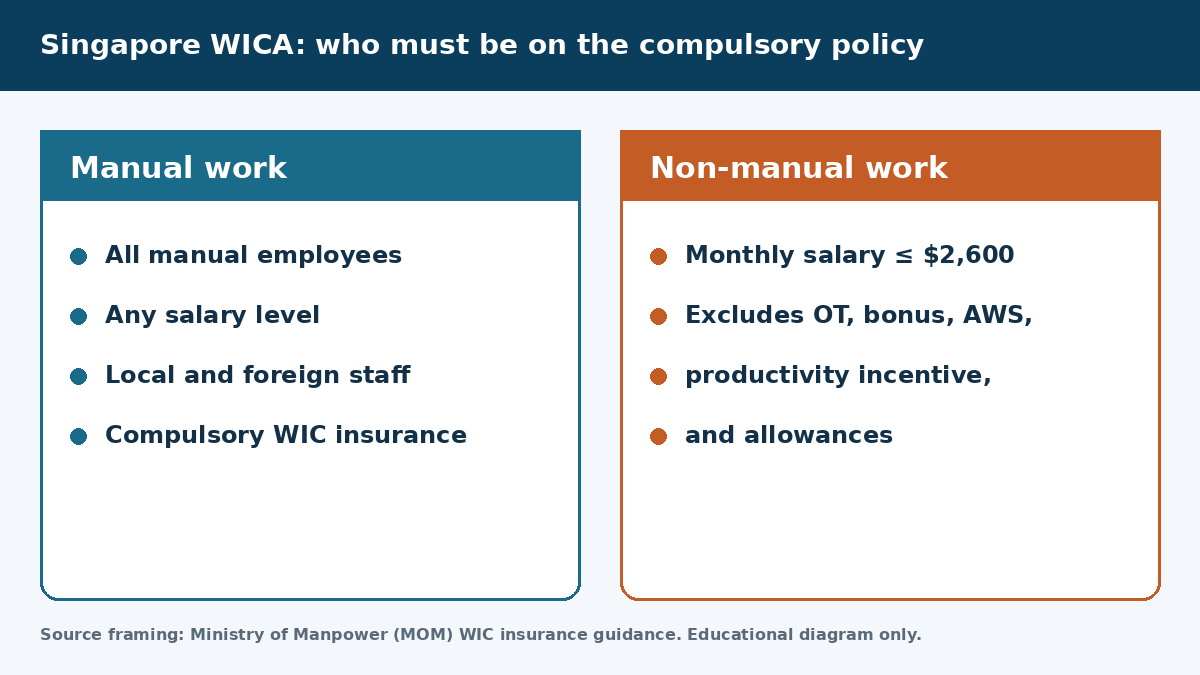
Practitioners who summarise work injury compensation insurance coverage usually start with this headcount map, then check occupation labels against payroll. That order beats starting from a premium quote.
What a WICA claim can actually pay
Eligible claims generally sit in three buckets: medical leave wages, medical expenses, and lump-sum compensation for permanent incapacity or death. Limits are statutory and have been updated by accident date (including medical expense caps from 1 November 2025). Use MOM’s types of compensation under WICA page for current figures rather than an old brochure.
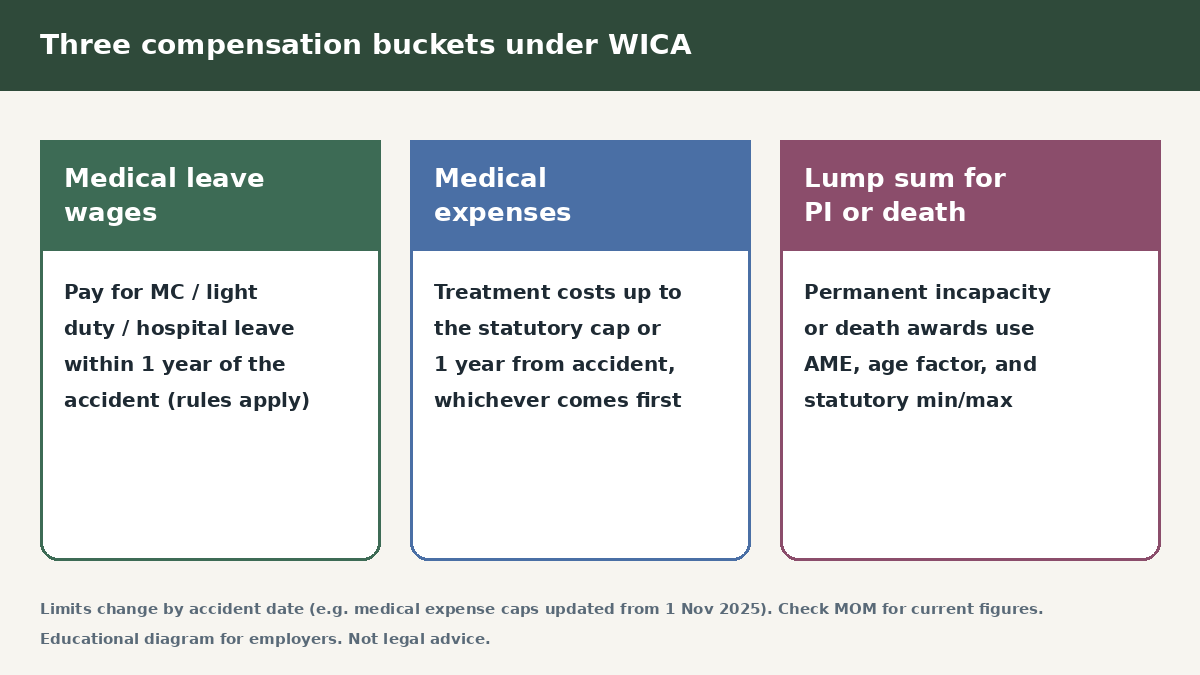
Employers still front medical leave wages and related expenses on the claim path, then seek reimbursement from the designated insurer. Waiting for the insurer before paying the injured employee is a common process mistake.
Designated insurers and the declaration problem
From 1 January 2021, WIC policies must come from a MOM-designated insurer and follow compulsory terms. Confirm cover early: MOM guidance asks employers to finalise contracts and give the insurer the needed information at least 21 days before commencement. Typical declaration fields include UEN, nature of business, aggregated headcount, aggregated annual wages, and occupations.
Under-declaring headcount or misstating occupations is how claims get messy. Project-site WIC add-ons are also a trap; employers still need their own WIC policy for their employees even when a project policy exists, and new project WIC policies should not be bought.
Related watch: Pro Bono SG’s educational overview of workplace injury claims in Singapore. Use it as orientation, then verify reporting and insurance steps on MOM.gov.sg.
The first ten days after an injury
When a work injury leads to medical leave, light duty, hospitalisation, or worse, the clock is short. Fatal cases need urgent notice to MOM, with an incident report within ten days. Non-fatal cases that meet reporting criteria generally need an incident report within ten days of the employer first learning of the accident. Notify the designated insurer promptly as well.
Keep a simple internal alert path so supervisors do not sit on MCs. Document occupation, place of work, and medical certificates early. Those details feed both the MOM report and the insurer file.
WICA does not replace every other staff cover conversation. Many employers still review a group personal accident layer for off-work or broader accident scenarios, and they budget employee medical benefits separately for day-to-day healthcare. Keep those lines labelled correctly so compulsory WIC never gets crowded out of the renewal calendar.
This quarter, pull one roster and mark who is manual, who is non-manual at or below $2,600, and who sits above the threshold without voluntary WIC. Cross-check that list against your current designated-insurer schedule before the next renewal quote lands.